
Public Safety & In-Building Wireless Solutions
Have a Project to Discuss?
From design and installation to inspection and compliance, we work with commercial properties to deliver reliable in-building wireless solutions.
Schedule a free consultation to review your project and next steps.
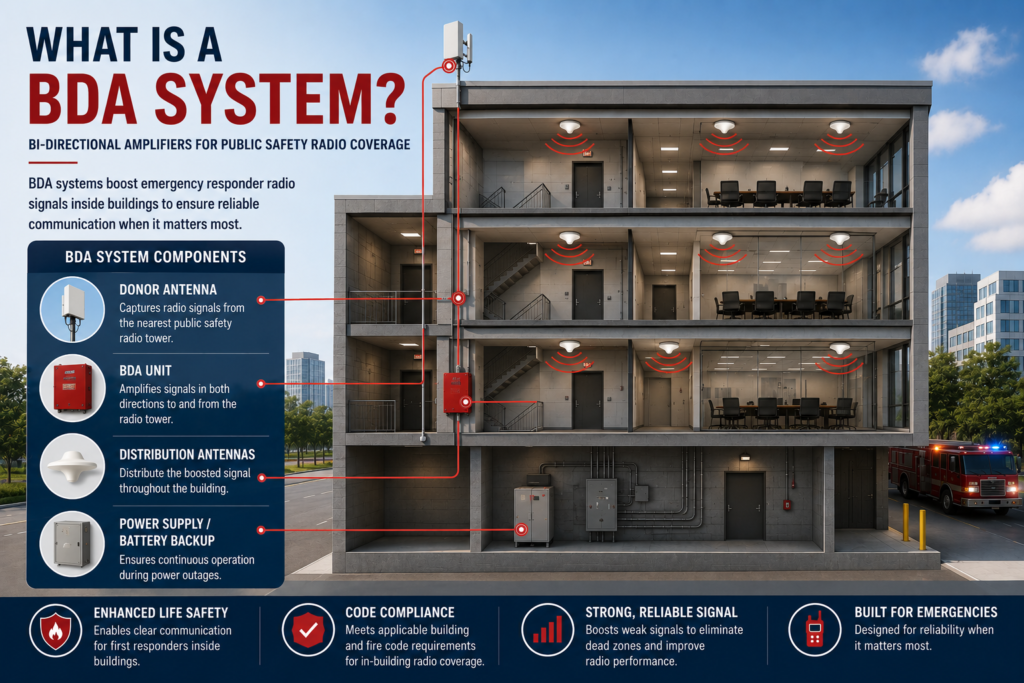
What Is a BDA System? A Complete Guide to Public Safety Radio Coverage
What Is a BDA System?
A BDA system, short for Bi-Directional Amplifier system, is designed to improve public safety radio communication inside buildings.
When firefighters, police officers, or emergency responders enter a building, they rely on portable radios to communicate with dispatch and each other. In many buildings, those radio signals become weak or completely unavailable once responders move indoors.
A BDA system installation solves this problem by capturing existing public safety radio signals, amplifying them, and distributing them throughout the building.
These systems are commonly installed as part of an ERRCS (Emergency Responder Radio Communication System) to help buildings meet fire code requirements.
Why Buildings Have Poor Radio Coverage
Modern buildings are one of the biggest causes of radio signal loss.
Construction materials such as:
- Reinforced concrete
- Structural steel
- Low-E energy efficient glass
- Metal roofing systems can weaken or block radio signals used by first responders.
Large buildings also create coverage challenges due to:
- Stairwells
- Elevator shafts
- Underground parking garages
- Mechanical rooms
- Thick interior walls
Even buildings located near strong radio towers may still have poor signal inside.
Without a properly designed BDA system, communication gaps can occur during emergencies.
What Does a BDA System Do?
A BDA system strengthens radio communication throughout a building.
The system works by:
- Receiving radio signals from a nearby public safety network
- Amplifying those signals using a Bi-Directional Amplifier
- Distributing the signal throughout the building using antennas
- Allowing portable radios inside the building to communicate back to the network
The term “bi-directional” means the system amplifies signals in both directions.
This includes:
- Downlink communication (into the building)
- Uplink communication (back out to the radio network)
Reliable communication in both directions is critical during emergency situations.
Main Components of a BDA System
A properly designed BDA system includes several key components.
Bi-Directional Amplifier (BDA)
The BDA is the central component of the system.
It receives weak radio signals, amplifies them, and distributes them throughout the building.
Donor Antenna
The donor antenna is usually installed on the roof.
Its purpose is to capture radio signals from the nearest public safety radio tower.
Indoor Antennas
Indoor antennas distribute the amplified signal throughout the building.
These antennas are strategically placed in areas where coverage is typically weak.
Cabling
Specialized coaxial cabling connects the system components and carries the radio signal throughout the structure.
Battery Backup
Fire codes require BDA systems to continue operating during power outages.
Backup battery systems help maintain communication during emergencies.
Alarm and Monitoring Systems
Monitoring systems alert building personnel if issues occur such as:
- Power loss
- Low battery conditions
- Amplifier faults
- Signal failure
Many jurisdictions require these alarms to integrate with the building fire alarm system.
What Is ERRCS?
ERRCS stands for Emergency Responder Radio Communication System.
ERRCS is the fire code and compliance term commonly used by:
- Fire marshals
- AHJs (Authorities Having Jurisdiction)
- Engineers
- Contractors
- Building inspectors
A BDA system is typically one of the main components within an ERRCS solution.
When a building fails public safety radio testing, an ERRCS system with a BDA may be required to bring the property into compliance.

When Is a BDA System Required?
BDA systems are required when a building does not provide adequate radio coverage for first responders.
This requirement is often identified during:
- New construction inspections
- Certificate of Occupancy testing
- Renovations
- Annual inspections
- AHJ evaluations
Buildings that commonly require BDA systems include:
- Hospitals
- Hotels
- High-rise condominiums
- Office buildings
- Warehouses
- Parking garages
- Educational campuses
- Industrial facilities
If minimum signal strength levels are not met, the building may fail inspection until a compliant system is installed.
BDA System Requirements and Fire Codes
BDA systems are governed by national and local fire codes.
The most common standards include:
- Current NFPA Codes Used By Jurisdiction
- International Fire Code (IFC)
- Local AHJ requirements
These codes establish requirements for:
- Signal strength
- Battery backup
- Monitoring systems
- Radio coverage levels
- Testing procedures
- System survivability
Each city or county may enforce these standards differently, making local experience extremely important.
Common Areas Where Signals Fail
Certain areas inside buildings are known for weak radio coverage.
Stairwells
Concrete stairwells are one of the most common dead zones.
Parking Garages
Underground parking structures often block radio communication almost entirely.
Elevator Shafts
Metal construction can severely weaken radio signals.
Interior Rooms
Signals become weaker as they move deeper into the building.
These communication gaps create major safety concerns during emergencies.
How BDA Systems Are Tested
BDA systems must be professionally tested to verify compliance.
Testing usually includes:
- Grid-based signal testing
- Uplink and downlink verification
- Battery backup testing
- Alarm system testing
- Coverage verification in critical areas
- AHJ reporting and documentation
Buildings that fail testing must correct coverage issues before approval is granted.
Working with professionals who provide BDA inspection services helps ensure accurate testing and proper documentation.
Common Reasons Buildings Fail Inspection
Many buildings fail BDA testing due to preventable issues.
Common problems include:
- Poor design leading to incomplete building coverage
- Poor installation from technicians that are not specialized in BDA installations.
- Lack of knowledge in AHJ procedures
- Failure to follow local jurisdictions code
Improperly designed systems can also interfere with surrounding public safety radio networks.
This is why proper RF engineering and system commissioning are critical.
Why Early Planning Matters
One of the biggest mistakes building owners make is waiting too long to address public safety radio requirements.
If signal problems are discovered late in construction, retrofitting a BDA system can become expensive and time consuming.
Late-stage installations may require:
- Opening finished walls and ceilings
- Re-routing cabling
- Additional construction work
- Delays in obtaining occupancy approval
Planning for BDA systems during the design phase helps reduce costs and avoid delays.
Working with experienced providers for BDA installation services early in the project helps ensure smoother compliance.
BDA Systems for Existing Buildings
Many existing buildings were built before current public safety radio requirements became common.
As codes evolve, older properties may now require:
- Signal testing
- System upgrades
- New BDA installations
- Annual inspections
Common reasons existing buildings install BDA systems include:
- Failed inspections
- Renovations
- Coverage complaints
- AHJ enforcement
Retrofit systems can still provide excellent coverage when properly designed.
Benefits of a Properly Designed BDA System
A professionally engineered BDA system provides several important benefits.
Reliable Emergency Communication
Ensures first responders maintain communication throughout the building.
Fire Code Compliance
Helps buildings meet local and national requirements.
Improved Safety
Reduces communication failures during emergencies.
Faster Project Approvals
Helps avoid delays during inspection and occupancy approval.
Long-Term Reliability
Proper engineering reduces interference and future performance issues.
Why Professional Design Matters
BDA systems are specialized RF communication systems.
Improper installations can:
- Cause failed inspections
- Create radio interference
- Lead to compliance violations
- Impact emergency communication reliability
An experienced provider can:
- Conduct RF site surveys
- Design compliant systems
- Coordinate with AHJs
- Install and optimize equipment
- Perform testing and inspections
This helps ensure the system performs correctly and remains compliant over time.
Final Thoughts
BDA systems play a critical role in modern building safety.
As buildings continue to become larger and more signal-resistant, reliable public safety radio communication becomes increasingly important.
Understanding how BDA systems work helps building owners, developers, and contractors avoid costly delays while ensuring first responders maintain communication when it matters most.

Get Your Building Code-Compliant
If your building requires ERRCS compliance, public safety DAS, or BDA system installation, our team can help.
We provide RF site surveys, system design, installation, inspection, and ongoing compliance services for commercial buildings nationwide.
Schedule a free consultation to review your project and next steps.
Request a free quote for your BDA system or installation today and take the next step toward meeting code requirements and ensuring reliable public safety communication.