
Public Safety & In-Building Wireless Solutions
Have a Project to Discuss?
From design and installation to inspection and compliance, we work with commercial properties to deliver reliable in-building wireless solutions.
Schedule a free consultation to review your project and next steps.
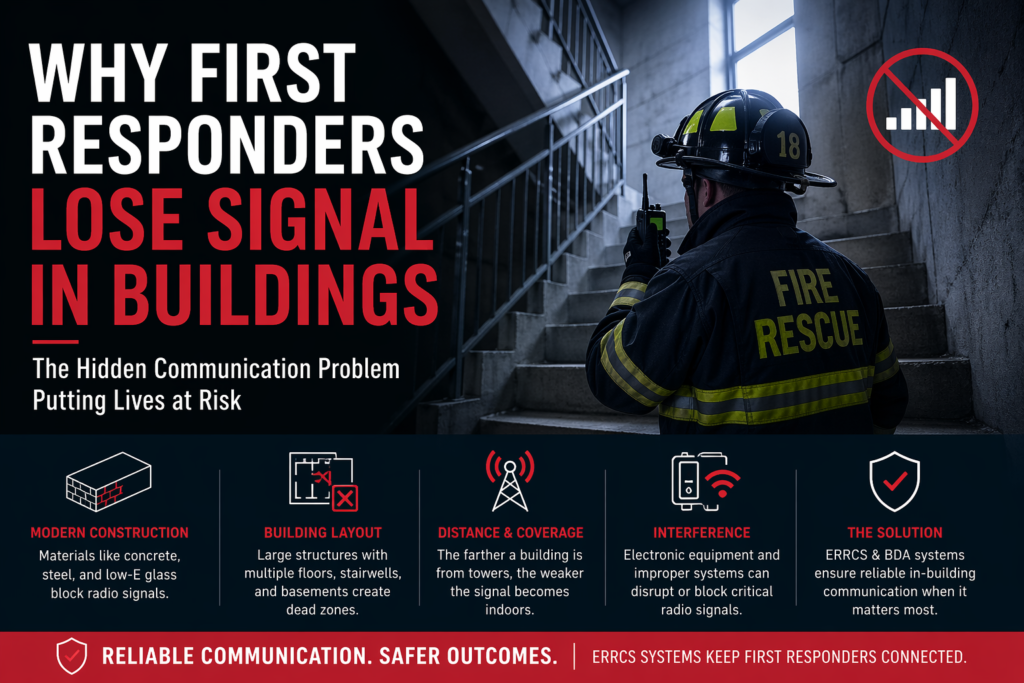
Why First Responders Lose Signal in Buildings
Reliable communication is one of the most critical tools first responders depend on during an emergency. Whether coordinating a fire response, navigating a large structure, or locating occupants, clear radio communication is essential.
Yet in many buildings, that communication breaks down.
It’s a common and serious issue. First responders often experience dropped signals, dead zones, or complete communication failure once they enter a structure. This isn’t a rare occurrence or an edge case. It’s a predictable result of how modern buildings are designed and constructed.
Understanding why this happens is the first step toward solving it.
The Reality of In-Building Signal Loss
Outside of buildings, public safety radio networks are designed to provide wide-area coverage. Towers and infrastructure are positioned to support communication across cities and regions.
But those systems are not designed to penetrate dense building materials or reach deep into large structures.
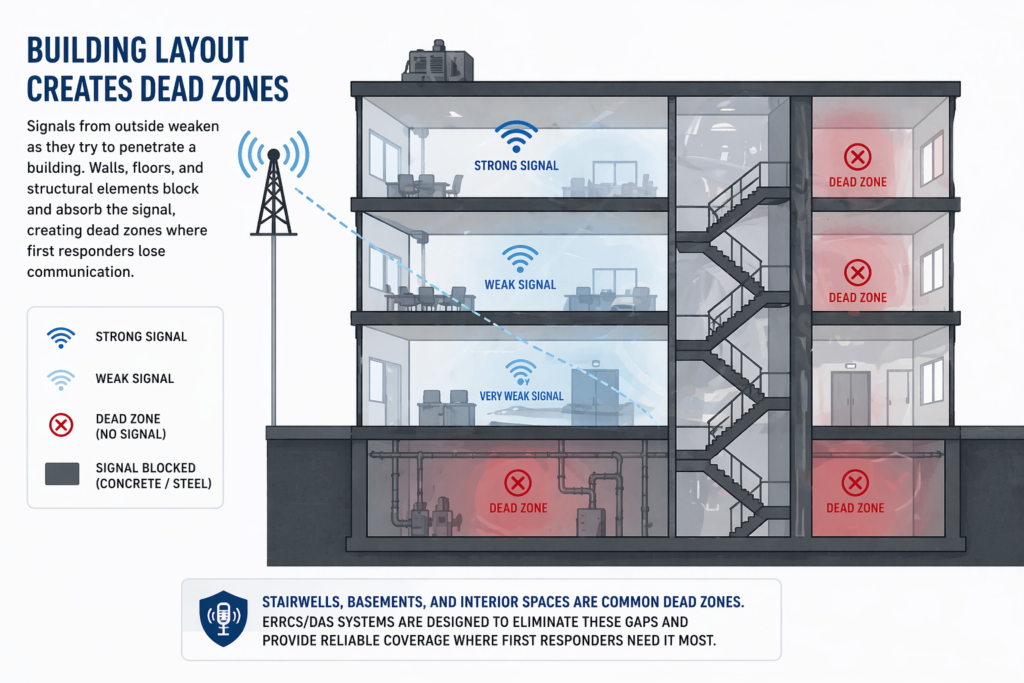
Once a responder moves indoors, signal strength can drop dramatically. In stairwells, basements, mechanical rooms, and interior hallways, communication may become unreliable or completely unavailable.
This is where the risk begins.
Modern Construction Is the Biggest Barrier
One of the primary reasons for signal loss is the materials used in modern construction.
Buildings today are designed for durability, energy efficiency, and insulation. While these are all positive advancements, they come with a downside for radio communication.
Common materials that block or weaken signals include:
- Reinforced concrete
- Structural steel
- Low-emissivity (Low-E) glass
- Metal roofing and siding
- Energy-efficient insulation systems
These materials absorb or reflect radio frequency signals, preventing them from traveling effectively throughout the building.
The larger and more complex the structure, the more pronounced the problem becomes.
Building Layout Creates Dead Zones
Even when some signal makes it into a building, it doesn’t distribute evenly.
Large structures often have:
- Multiple floors
- Thick interior walls
- Underground levels
- Stairwells and elevator shafts
These areas can create isolated pockets where signals simply don’t reach. Stairwells in particular are a known problem area, even though they are critical pathways during emergencies.
This uneven coverage results in what are commonly referred to as dead zones.
For first responders, these dead zones can disrupt coordination and slow response times when every second matters.
Distance From the Signal Source
Radio signals weaken over distance. The farther a building is from a public safety radio tower, the weaker the signal will be when it reaches the structure.
In suburban areas, industrial zones, or dense urban environments with interference, signal strength may already be limited before it even reaches the building.
Once that weaker signal encounters building materials, it degrades even further.
Interference and Signal Disruption
Another major factor is interference.
Buildings are filled with electronic systems that can impact radio frequency performance. Equipment such as HVAC systems, electrical infrastructure, and other wireless technologies can introduce noise into the environment.
In more complex scenarios, improperly designed amplification systems can make the problem worse.
This is where expertise becomes critical. A poorly implemented system can create interference issues that extend beyond the building itself. The “near-far effect” can occur when signals are over-amplified, disrupting nearby communications and potentially impacting wider radio networks.
This is one of the reasons professional design and testing are essential.
Why This Is a Serious Safety Issue
When first responders lose communication, the impact is immediate.
They may be unable to:
- Coordinate with team members
- Receive updated information
- Call for assistance
- Communicate hazards or conditions
In emergency situations, communication breakdowns can slow response times and increase risk for both responders and occupants.
This is why in-building radio coverage is not just a convenience. It is a safety requirement.
Code Requirements for Reliable Communication
To address these risks, building codes now require that certain structures provide adequate in-building radio coverage.
ERRCS (Emergency Responder Radio Communication Systems) are designed to meet these requirements. These systems ensure that radio signals are available throughout a building, including critical areas such as stairwells and basements.
Compliance is enforced by local Authorities Having Jurisdiction (AHJs), and buildings must meet specific signal strength thresholds before receiving approval.
Working with experienced providers for BDA installation services ensures that systems are properly designed to meet these requirements and avoid costly delays.
How ERRCS and BDA Systems Solve the Problem
ERRCS systems are designed to bring reliable communication inside buildings where signals would otherwise fail.
In most cases, this is achieved using a BDA (Bi-Directional Amplifier), which captures external radio signals, amplifies them, and distributes them throughout the building using a network of antennas.
For larger or more complex structures, a distributed antenna system may be used to provide consistent coverage across multiple floors or buildings.
The result is clear, reliable communication for first responders, regardless of where they are inside the structure.
The Importance of Testing and Ongoing Compliance
Installing a system is not enough. Ongoing testing is required to ensure performance remains consistent.
ERRCS systems must be inspected and tested periodically to verify signal strength, coverage, and system functionality. Documentation is required to demonstrate compliance with applicable codes.
Working with professionals who specialize in BDA inspection services ensures accurate testing and proper reporting for regulatory approval.
Without proper testing, systems can degrade over time and fall out of compliance.
When to Address Signal Issues
One of the most common mistakes building owners make is waiting too long.
Signal issues should be identified and addressed during the design phase of a project. Waiting until construction is complete can lead to higher costs, delays, and more complex installations.
Early planning allows for better system integration and a smoother path to compliance.
Common Signs Your Building Has a Problem
Many buildings already have signal issues without realizing it.
Warning signs include:
- Dropped radio communication indoors
- Poor signal in stairwells or basements
- Failed inspection reports
- AHJ requirements for system installation
If any of these are present, a system may be required.
Why Experience Matters
ERRCS and BDA systems are not simple installations. They require specialized knowledge of RF engineering, building codes, and compliance requirements.
An experienced provider can:
- Conduct accurate RF surveys
- Design systems that meet code requirements
- Avoid interference issues
- Ensure proper installation and testing
- Provide documentation for approval
This reduces risk and helps ensure a successful outcome.
Final Thoughts
First responders lose signal in buildings because modern construction, building design, and distance from signal sources all work against reliable communication.
It’s not a flaw in the system. It’s a known limitation that must be addressed.
ERRCS and BDA systems provide the solution, ensuring that communication remains reliable when it matters most.
For building owners and developers, understanding this issue is key to maintaining safety, meeting code requirements, and avoiding costly delays.

Get Your Building Code-Compliant
If your building requires a Public Safety DAS or BDA system, it’s important to get it done right the first time. From system design to installation and inspection, having the right team ensures a smoother approval process and long-term compliance.
We provide professional BDA and ERRCS solutions for commercial properties, including system design, installation, and testing.
Request a free quote for your BDA system or installation today and take the next step toward meeting code requirements and ensuring reliable public safety communication.