
Public Safety & In-Building Wireless Solutions
Have a Project to Discuss?
From design and installation to inspection and compliance, we work with commercial properties to deliver reliable in-building wireless solutions.
Schedule a free consultation to review your project and next steps.
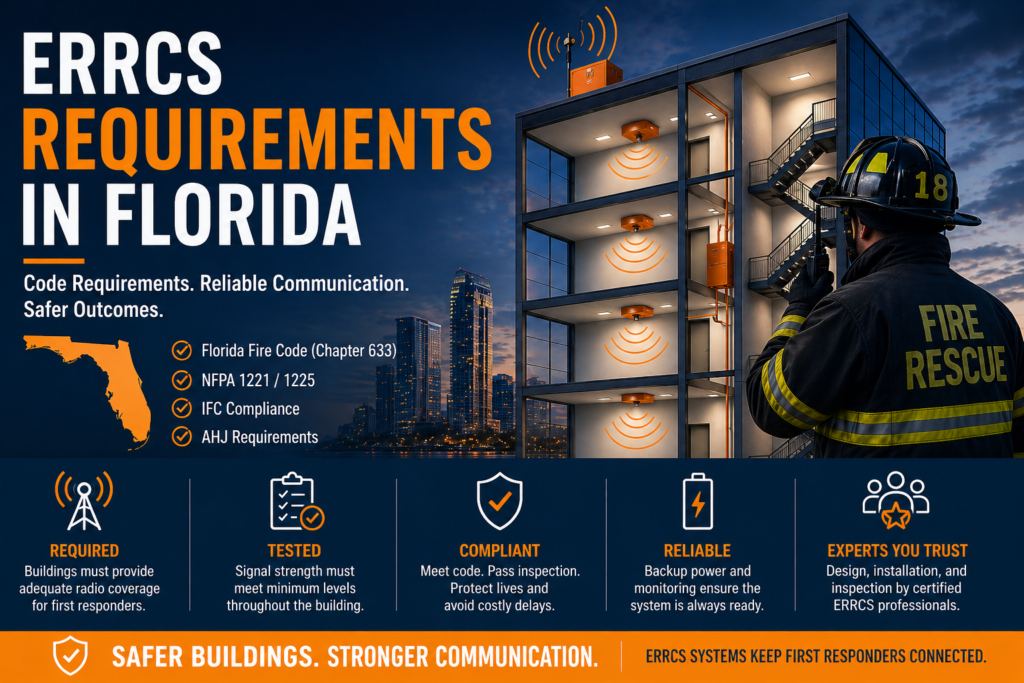
ERRCS Requirements in Florida
Reliable communication for first responders is not optional in Florida. It is a code requirement.
Across the state, commercial buildings must provide adequate in-building radio coverage for emergency personnel. When signal strength is insufficient, an ERRCS (Emergency Responder Radio Communication System) is required to meet compliance standards.
For building owners, developers, and contractors, understanding these requirements early is critical. Failing to meet them can lead to failed inspections, costly retrofits, and delays in obtaining a Certificate of Occupancy.
What Is an ERRCS System?
An ERRCS is a system designed to ensure reliable radio communication inside buildings for first responders.
Most ERRCS systems include:
- A BDA (Bi-Directional Amplifier) to boost signal
- A network of antennas to distribute coverage
- Monitoring and backup systems for reliability
In smaller to mid-size buildings, a BDA-based system is typically sufficient. Larger or more complex structures may require a fiber-based DAS solution to maintain consistent coverage throughout the building.
Why Florida Requires ERRCS Systems
Modern construction materials like concrete, steel, and low-E glass block radio signals, making it difficult for public safety networks to penetrate buildings.
Even buildings located in strong outdoor coverage areas often fail to provide reliable indoor communication.
To address this, Florida fire codes require buildings to meet minimum signal strength levels throughout the structure, including critical areas such as:
- Stairwells
- Basements
- Mechanical rooms
- Fire command centers
If those levels are not met, an ERRCS system becomes mandatory.
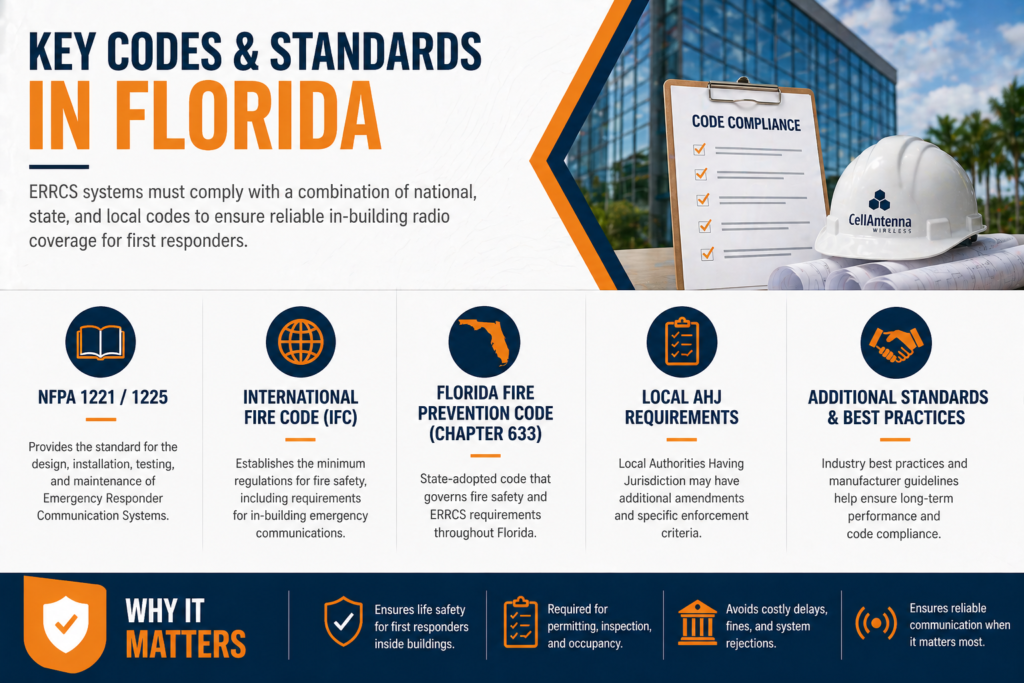
Key Codes and Standards in Florida
ERRCS requirements in Florida are based on a combination of national and local codes, including:
- NFPA 1221 / NFPA 1225
- International Fire Code (IFC)
- Florida Fire Prevention Code (Chapter 633)
- Local AHJ (Authority Having Jurisdiction) requirements
Each jurisdiction may enforce these standards slightly differently, which is why local experience is important.
Signal Strength Requirements
To pass inspection, buildings must meet minimum signal levels for both:
- Downlink (signal entering the building)
- Uplink (signal transmitted back to the network)
Testing is conducted using a grid-based approach across the entire building.
Any areas that fail to meet required thresholds must be corrected before approval is granted.
When an ERRCS System Is Required
An ERRCS system is typically required when:
- New construction fails initial signal testing
- Existing buildings do not meet updated code requirements
- Renovations impact signal coverage
- AHJs mandate compliance upgrades
In many cases, this requirement is discovered late in the process, which can lead to delays.
The Importance of Early Planning
Waiting until inspection to address ERRCS requirements is one of the most common and costly mistakes.
Late-stage installations often require:
- Opening finished walls and ceilings
- Re-routing cabling
- Additional labor and delays
Planning for ERRCS during the design phase allows for a more efficient and cost-effective solution.
Working with experienced providers for ERRCS installation ensures the system is properly designed from the start.
Common Issues That Lead to Failure
Buildings often fail ERRCS testing due to:
- Poor system design
- Incomplete coverage in critical areas
- Improper antenna placement
- Signal interference
Improperly designed systems can also create interference with nearby radio networks, particularly due to the near-far effect.
This is why professional RF design and engineering is essential.
Testing and Inspection Requirements
Once installed, ERRCS systems must be tested to verify compliance.
This includes:
- Grid testing for signal strength
- Battery backup verification
- Alarm and monitoring system checks
- Documentation for AHJ approval
Ongoing inspections are also required to maintain compliance over time.
Working with certified providers for ERRCS inspection companies ensures accurate testing and reporting.
Ongoing Maintenance and Compliance
ERRCS systems require regular maintenance to remain compliant.
Over time, systems can degrade due to:
- Equipment wear
- Environmental conditions
- Changes in surrounding signal environments
Routine inspections ensure the system continues to meet code requirements and perform reliably.
South Florida Considerations
In South Florida, ERRCS requirements are often strictly enforced due to dense construction and complex building environments.
Counties such as:
- Miami-Dade
- Broward
- Palm Beach
may have specific AHJ expectations, testing procedures, and documentation standards.
Understanding these local nuances is critical for passing inspection.
Why Experience Matters
ERRCS systems require expertise in RF engineering, compliance standards, and system design.
An experienced provider can:
- Conduct RF site surveys
- Design compliant systems
- Prevent interference issues
- Ensure proper installation and testing
- Provide documentation for approval
This helps avoid delays and ensures a smooth path to compliance.
Final Thoughts
ERRCS requirements in Florida are a critical part of building safety and compliance.
Understanding these requirements early allows building owners and developers to avoid costly delays and ensure that first responders have reliable communication when it matters most.

Get Your Building Code-Compliant
From design to installation and inspection, having the right team ensures a smoother approval process and long-term compliance.
We provide professional BDA and ERRCS solutions for commercial properties, including system design, installation, and testing.
Request a free quote for your BDA system or installation today and take the next step toward meeting code requirements and ensuring reliable public safety communication.